Economical system format
Focus the configuration on pressure, diameter, wall and optional flow endpoints without paying for longitudinal force measurement.
The DMT 114PN is a pressure myograph for experiments on pressurized small arteries, veins and other vessels under near-physiological conditions. It is designed for researchers who need static-pressure, vessel-diameter or flow-related studies without longitudinal force measurement, providing a more economical pressure-myograph configuration.
The 114PN retains the core pressure, cannulation, heating and vessel-tracking workflow of the 114P while omitting the force transducer and associated positioning mechanism.
Focus the configuration on pressure, diameter, wall and optional flow endpoints without paying for longitudinal force measurement.
Study intact vessels under controlled transmural pressure and add the FlowMeter – 162FM where flow measurement is required.
Mount small arteries, veins and other vessels between two cannulas while preserving tubular vessel geometry.
Maintain chamber temperature without relying on continuous superfusion as the only heating method.
Stainless-steel construction supports routine cleaning and helps reduce adhesion of lipids and compounds.
Measure vessel and lumen diameter, wall thickness, pressure and calculated vascular parameters throughout the protocol.
A small intact artery or vein is mounted onto two cannulas and pressurized to the required transmural pressure. This preserves tubular vessel geometry while allowing diameter, lumen, wall dimensions and pressure-dependent responses to be monitored.
Compared with the 114P, the 114PN removes longitudinal force measurement. It is therefore suited to experiments where vessel diameter, wall structure, pressure response or flow-related function are the relevant endpoints.
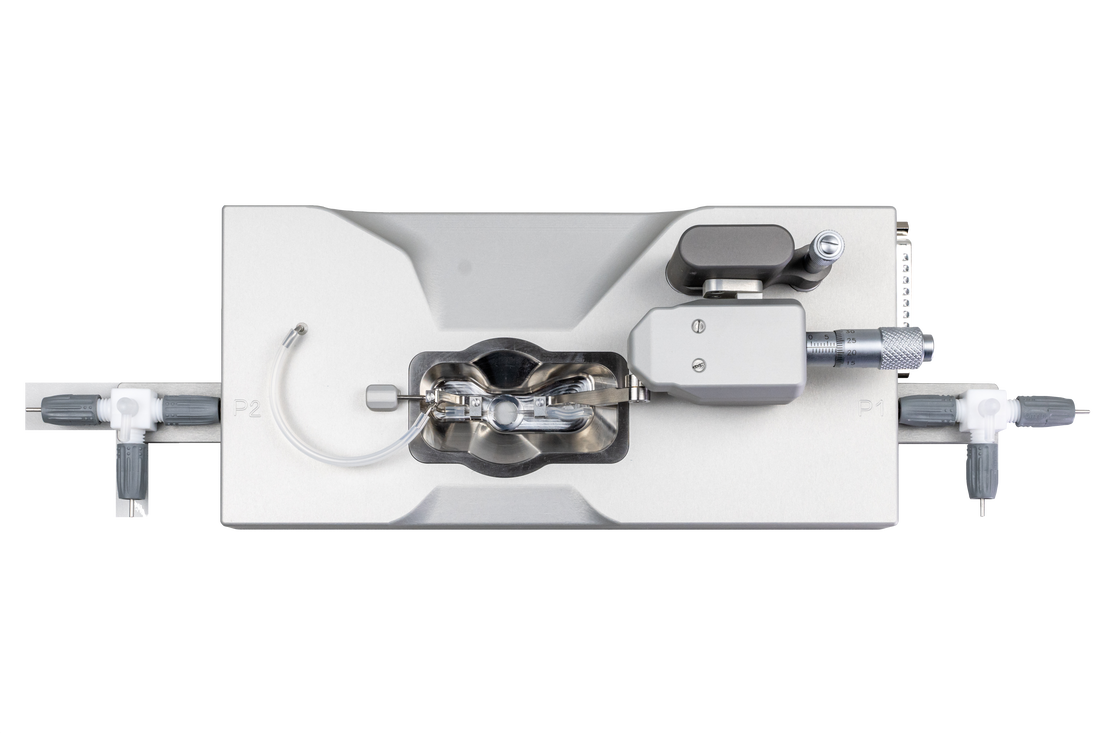
The 114PN chamber is designed for mounting pressurized vessels between two cannulas. Integrated pressure transducers, XYZ alignment and an optical base window support controlled pressure, visualization and flow-related studies.
The 114PN is suited to studies where the biological question depends on the behavior of an intact pressurized vessel and longitudinal force measurement is not required.
Study pressure-dependent constriction and dilation under controlled transmural pressure.
Investigate endothelial responses to controlled luminal flow when configured with a FlowMeter.
Measure diameter changes following luminal or abluminal exposure to vasoactive compounds.
Track vessel and lumen dimensions during controlled pressure steps.
Calculate flow-dependent parameters when the system is paired with the relevant flow workflow.
The 114PN workflow combines a cannula-based pressure chamber, pressure-control interface and software for live tracking and analysis.
Cannula-based chamber for pressurized-vessel studies without longitudinal force measurement.
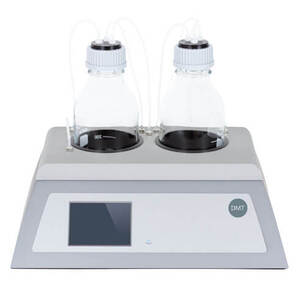
Interface with heated reservoir, touch-screen pressure control, calibration procedures, chamber heating and direct data communication.
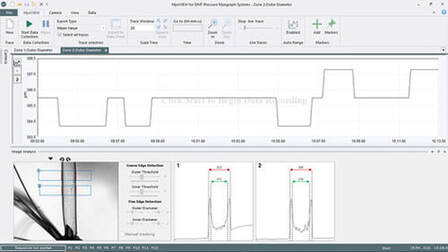
Software workflow for live vessel detection, dimension tracking, pressure acquisition and pressure-myograph calculations.
MyoVIEW collects vessel-wall thickness, vessel and lumen diameter, intravascular pressure and calculated parameters throughout pressure, flow and pharmacological protocols.
Core chamber, pressure, temperature, reservoir and communication specifications for evaluating the 114PN.
The appropriate configuration depends on vessel dimensions, microscope and camera compatibility, cannula format, pressure circuit, optional flow measurement, software requirements and laboratory training needs.
Typical workflows include MyoVIEW, computer package, inverted microscope, camera, stage micrometer, vacuum package, heating bath or circulator, dissection microscope, light source and dissection tools.
Confirm cannula dimensions, pressure tubing, peristaltic pump requirements and FlowMeter – 162FM where flow measurement is part of the protocol.
Installation, cannulation training, pressure calibration, leak testing, spare pressure transducers and maintenance coverage help support consistent operation.
The 114PN is designed to study small arteries and veins under near-physiological pressure conditions without longitudinal force measurement. It allows researchers to measure vessel diameter, wall thickness, myogenic responses, endothelial function, and flow-dependent vascular behavior in a more economical configuration.
The 114PN is designed for small arteries, veins, and other cannulated vessels larger than 40 µm. It preserves the vessel's natural tubular structure, making it ideal for pressure- and flow-based vascular physiology studies.
The system measures vessel diameter, lumen diameter, wall thickness, intravascular pressure, pressure-diameter relationships, myogenic tone, and flow-mediated responses. When used with MyoVIEW, researchers can also calculate vascular resistance, shear stress, and other derived vascular parameters.
Yes. The 114PN is ideal for myogenic tone, flow-mediated dilation, endothelial function, vascular reactivity, and pharmacological studies where vessel diameter and pressure are the primary experimental endpoints. Optional FlowMeter integration supports controlled luminal flow experiments.
The 114PN offers the same pressure myography workflow as the 114P but does not include longitudinal force measurement. It's the ideal choice for laboratories focused on vessel diameter, pressure, wall structure, and flow studies that don't require axial force data, making it a more cost-effective solution.
The 114PN is widely used in vascular biology, hypertension, endothelial dysfunction, flow-mediated dilation, vascular remodeling, pharmacology, and microvascular research where pressure- and diameter-based measurements are the primary focus.
Not always. If your research focuses on vessel diameter, pressure, flow, endothelial function, or myogenic responses, the 114PN provides all the essential pressure myography capabilities without longitudinal force measurement. If your protocols require measuring axial vessel tension, the 114P is the better choice.
The 114PN is an excellent choice if your research focuses on small-vessel pressure myography, flow-mediated studies, vascular reactivity, and vessel diameter measurements without the need for longitudinal force data. If your experiments require axial force measurements, consider the 114P. If you need pulsatile pressure simulation, the 112PP is the better option.
Use the official DMT documents and related pages when evaluating, configuring or operating the 114PN.
Product overview, applications and technical specifications.
→ PDFDetailed system setup, pressure circuit, interface and calibration documentation.
→ PDFPractical reference for mounting and routine system operation.
→ PDFSoftware documentation for pressure-myograph tracking and analysis.
→ VIEWLive vessel tracking and analysis for DMT pressure myographs.
→ FLOWOptional flow measurement for compatible pressure-myograph protocols.
→ CMPCompare the 114PN with other DMT pressure-myograph systems.
→ SUPPlan system setup, cannulation, calibration and user onboarding.
→Share the vessel type and diameter, pressure range, flow needs, microscope and camera setup, cannula preference and intended MyoVIEW analysis. DMT can help confirm whether the 114PN is the appropriate pressure-myograph configuration.