Four independent baths
Program, start and stop up to four muscle-strip experiments separately while maintaining individual chamber control.
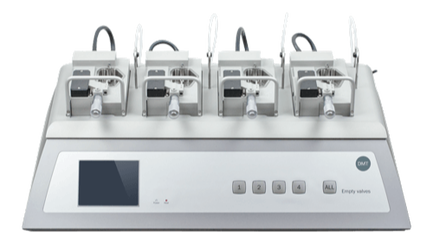
The DMT 840MD is a four-channel MyoDynamics system for functional studies of intact muscle and muscle strips up to 30 mm in length. It combines precise force measurement, programmable motorized length control, stimulation timing and independently controlled bath conditions in one integrated platform.
The 840MD is designed for muscle physiologists who need independent, parallel experiments rather than a single force measurement. Each channel combines a sensitive force transducer, manual preload adjustment and programmable motor movement.
Program, start and stop up to four muscle-strip experiments separately while maintaining individual chamber control.
Perform isometric, eccentric and concentric studies using force measurement together with controlled motor movement.
Stretch or retract the preparation from 10 µm up to 11 mm at user-defined speeds from 0.5 to 12 mm/sec.
Optional chamber-cover electrodes support direct or field stimulation using compatible DMT stimulators.
Individually regulated heating, gassing, suction and drainage help maintain stable experimental conditions.
Four separated preparations support drug testing, intervention comparisons, fatigue studies and multi-condition protocols.
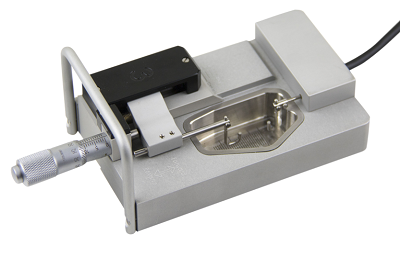
Each aluminium bath unit contains a stainless-steel chamber with tissue supports on either side. One support is connected to a sensitive force transducer, while the other is connected to a combined manual preload mechanism and motorized micropositioner.
The manual positioner establishes the initial preload. The motor then stretches or retracts the preparation according to user-defined protocol commands, enabling controlled eccentric and concentric experiments.
The 840MD combines force measurement with active control of muscle length. This allows the same system to support static-force studies and protocols involving programmed lengthening or shortening.
The 840MD is suited for contractile and electrophysiological studies where force, length and stimulation timing must be controlled together.
Its four-channel layout supports parallel comparisons between healthy, diseased, treated and untreated preparations.
Study dystrophic muscle, ataxia-related models, mechanome-affected muscle and myofibrillar myopathies.
Investigate force effects associated with glycolysis, glycogen metabolism and fatty-acid conversion.
Evaluate muscle-force changes associated with altered excitation, stimulation and ion-channel function.
Apply repeated stimulation and motor-controlled length changes in fatigue or eccentric-damage protocols.
Compare drugs, treatment groups and experimental conditions across four independent preparations.
The 840MD controller supports user-defined commands for motor movement, force conditions, timing and digital trigger behaviour.
The 840MD combines four muscle chambers, force transducers, motorized micropositioners and an integrated controller for protocol programming, environmental control and data output.
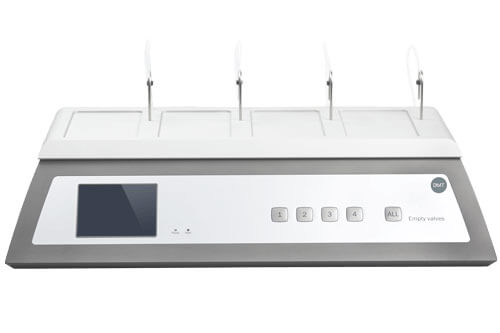
Integrated controller and four independently operated bath units for parallel muscle contraction and intervention studies.
Stainless-steel chamber with tissue supports, force transducer, manual preload control and motorized length adjustment.
Chamber, movement, force, temperature and data-output specifications for planning a complete 840MD installation.
The correct configuration depends on preparation type, muscle length, expected force output, contraction mode, stimulation needs, acquisition setup and required chamber volume.
Define the muscle type, preparation length, minimum segment size and whether the primary workflow is isometric, eccentric, concentric, fatigue, intervention or screening.
Select the appropriate force range from ±200 to ±1600 mN and confirm whether direct or field stimulation and compatible DMT stimulator integration are required.
A complete workflow may require PowerLab acquisition, a computer, dissection microscope, light source, dissection tools, heating circulator, vacuum package, gas manifold and pH equipment.
The MyoDynamics 840MD is used to measure the function and mechanics of isolated muscle tissue. It enables researchers to evaluate muscle force, contraction, fatigue, and length changes under controlled laboratory conditions, making it ideal for skeletal, cardiac, and smooth muscle research.
The 840MD is designed for skeletal muscle, cardiac muscle, and other isolated muscle strips up to 30 mm in length. It is ideal for researchers studying muscle physiology, disease models, and functional responses under controlled laboratory conditions.
The system measures isometric force, eccentric and concentric contractions, fatigue, muscle reactivity, and length-tension relationships. It also supports programmable stretch and motor-controlled movement for advanced muscle mechanics experiments.
Yes. The 840MD is specifically designed for fatigue and repeated contraction protocols, making it well suited for neuromuscular disease research, exercise physiology, and studies of muscle performance and recovery.
Yes. The system supports optional direct or field stimulation when paired with DMT's CS4+ or CS8 Stimulator, allowing researchers to perform twitch, tetanic, and other stimulation-based muscle experiments.
The 840MD is widely used in skeletal muscle physiology, cardiac muscle research, neuromuscular disorders, muscular dystrophy, metabolic disease, pharmacology, and drug development where precise muscle function measurements are required.
The 840MD measures active muscle function, including contraction, relaxation, fatigue, and stimulation responses. The 560TP is designed for passive tissue mechanics, such as stiffness, elasticity, tensile strength, and stress-strain analysis. The right system depends on whether your research focuses on active muscle physiology or passive biomechanical properties.
Choose the 840MD if your research focuses on muscle contraction, force generation, fatigue, electrical stimulation, or length-tension relationships. If your primary goal is measuring passive tissue mechanics like stiffness or compliance, the Tissue Puller 560TP is likely the better fit.
Use the official product documentation and protocol material when evaluating, configuring or operating the 840MD system.
Product overview, applications, specifications and configuration guidance.
→ PDFTechnical guidance for setup, operation, calibration, protocols and maintenance.
→ PDFPractical guidance for system preparation and routine experimental operation.
→ PDFProtocol information for electrophysiological and muscle contraction studies.
→ DMTCompare DMT systems for muscle function and tissue mechanics.
→ DOCBrowse supporting scientific and application material from DMT.
→ SUPPlan laboratory setup, onboarding and application-focused training.
→ DMTDiscuss muscle preparation, force range, stimulation and acquisition requirements with DMT.
→