DMT
  • Products
    • Muscle Strip Systems >
      • Tissue Puller System - 560TP
      • MyoDynamics Muscle Strip System - 840MD
    • Organ Bath System >
      • Organ Bath System - 751MT
      • Organ Bath System - 752eT
      • Organ Bath System | 820MO
    • Pressure Myograph Systems >
      • Pressure Myograph System - 110PXL
      • Pressure Pulsation Myograph System - 112PP
      • Pressure Myograph System - 114P
      • Pressure Myograph System - 114PB
      • Pressure Myograph System - 114PN
      • Pressure Myograph System - 120CP
    • Wire Myograph Systems >
      • Single Wire Myograph System - 320A
      • Confocal Wire Myograph System - 360CW
      • Dual Wire Myograph System - 420A
      • Multi Wire Myograph System - 620M
      • Automated Multi Myograph System - 630MA
    • Myograph Software >
      • MyoNORM
      • MyoDAQ Acquisition
      • MyoVIEW 5
      • MyoPULSE
    • Accessories & Parts >
      • Buffer Filler System
      • FlowMeter - 162FM
      • Stimulators >
        • Stimulator - CS4+
        • Stimulator - CS8
  • Resources
    • DMT Academy >
      • Product Videos
      • Practical Guides
      • Protocols & Articles
    • Guides & Manuals
    • Training/Installation
    • System Maintenance
    • Software Downloads
  • DMT Insights
    • Latest News
    • Lab Spotlight
    • Installation Stories
  • About us
  • Contact
Muscle Strip & Tissue Mechanics Systems

Systems for active muscle function and passive tissue mechanics

DMT muscle strip and tissue mechanics systems support researchers studying isometric contraction, force transients, electrical stimulation, length-tension relationships, tensile strength, compliance, stiffness and stress-strain behavior in isolated vascular, skeletal, cardiac and other tissue preparations.

Compare systems Request a quote Ask DMT for guidance
Active contraction Isometric, twitch, tetanic and stimulation-dependent force.
Passive mechanics Tensile strength, compliance, stiffness and stress-strain.
Two system directions 840MD for active studies and 560TP for tensile mechanics.
DMT MyoDynamics Muscle Strip System 840MD chamber
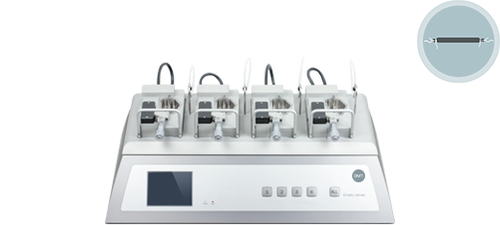
DMT Tissue Puller System 560TP
System selection Match the platform to the primary biological endpoint
Measurement endpoints

Choose the system according to what the tissue must reveal

Muscle strip and tissue mechanics experiments generally divide into two measurement directions: active force generation and passive biomechanical response.

Active muscle mechanics

Contraction, relaxation and stimulation-dependent force

Measure how isolated muscle preparations generate force, respond to preload, contract following electrical stimulation and recover during repeated or fatigue protocols.

Isometric contraction Twitch force Tetanic force Force-frequency Fatigue Relaxation kinetics
Passive tissue mechanics

Tensile strength, stiffness and stress-strain behavior

Characterize how vascular, muscular or tubular tissue responds to controlled stretch, repeated loading and tissue failure under defined mechanical conditions.

Tensile strength Compliance Elasticity Viscoelasticity Stress-strain Fatigue profile
Research applications

Functional and biomechanical assessment of isolated tissues

DMT muscle systems support studies of how tissue generates force, responds to stretch, relaxes after stimulation and changes with disease, treatment, ageing or genetic modification.

The appropriate platform depends on whether the main endpoint is active contraction, transient force, passive stiffness or controlled tensile behavior.

Skeletal muscle Cardiac muscle Vascular tissue Tubular tissue Muscle disease Biomechanics Pharmacology Phenotyping
01

Muscle contraction and relaxation

Measure peak force, time-to-peak, relaxation behavior and contraction kinetics in isolated muscle strips.

02

Electrical stimulation studies

Investigate twitch, tetanic, force-frequency and repeated stimulation responses under controlled field-stimulation conditions.

03

Length-tension and preload studies

Establish how preparation length or preload influences active force generation and muscle performance.

04

Tissue stiffness and remodeling

Quantify compliance, stiffness, elasticity and structural remodeling in vascular or muscular tissues.

05

Disease and intervention phenotyping

Compare control, disease, genetic, treatment or ageing groups using functional or biomechanical endpoints.

06

Fatigue and recovery

Study force decline, repeated loading, recovery and mechanical integrity across defined experimental protocols.

Systems

Compare DMT muscle strip and tissue mechanics platforms

Select the system according to whether the experiment requires controlled tensile testing or active muscle contraction with electrical stimulation and chamber-level control.

DMT Tissue Puller System 560TP
Passive tissue mechanics

Tissue Puller System – 560TP

A compact tensile testing system for biomechanical characterization of isolated tissue rings, tubular preparations and strips. The 560TP records force and displacement during programmable controlled pulling.

Primary endpoint Tensile strength, compliance, stiffness and stress-strain.
Preparation types Vessel rings, tubular samples and tissue strips.
Pull control Programmable motorized pull speed and pull length.
Typical use Vascular stiffness, remodeling, fatigue and tissue integrity.
View 560TP Request quote
DMT MyoDynamics Muscle Strip System 840MD
Active muscle mechanics

MyoDynamics Muscle Strip System – 840MD

A muscle strip system for controlled stretch, preload and electrically stimulated contraction studies. The chamber supports larger isolated muscle strips and striated muscle preparations up to 30 mm.

Primary endpoint Active contraction, twitch, tetanus and force kinetics.
Preparation types Skeletal, cardiac and other larger muscle strips.
Stimulation Controlled electric field stimulation workflows.
Typical use Muscle function, fatigue, disease and intervention studies.
View 840MD Request quote
Quick comparison

First-pass guide to selecting the right system

Use the comparison below to identify the most relevant platform before reviewing the individual product pages or discussing the application with DMT.

Selection factor 560TP Tissue Puller 840MD MyoDynamics
Primary measurement Passive tensile mechanics, force-displacement and stress-strain response. Active muscle contraction, relaxation and stimulation-dependent force.
Typical tissue Vessel rings, tubular tissue and tissue strips. Skeletal, cardiac and other larger isolated muscle strips.
Mechanical control Programmable controlled pulling with force and displacement recording. Controlled length, preload, stretch-retract and chamber-based contraction measurement.
Electrical stimulation Not the primary system function. Designed for electric field stimulation workflows.
Typical endpoints Tensile strength, compliance, stiffness, viscoelasticity, fatigue and failure response. Peak force, twitch, tetanus, force-frequency, fatigue, time-to-peak and relaxation.
Best fit Studies focused on passive biomechanical tissue properties. Studies focused on active muscle function and stimulation.
Product page View 560TP View 840MD
Research fit

Experimental considerations before choosing a system

Muscle and tissue mechanics experiments vary significantly by tissue type, preparation size, force range, contraction speed, stimulation method and mechanical endpoint.

Preparation geometry

Define whether the sample is a vessel ring, tubular segment, skeletal muscle strip, cardiac preparation or another tissue format.

Active or passive endpoint

Determine whether the main measurement is active force generation or passive tensile behavior under controlled stretch.

Expected force range

Estimate the expected force output so the transducer and system range match the preparation.

Contraction speed

Fast twitch and relaxation responses may require higher-fidelity acquisition than slow tensile or remodeling studies.

Stimulation method

Confirm whether electric field stimulation, direct stimulation, pharmacological exposure or controlled pulling is required.

Analysis requirements

Define whether the analysis must include peak force, kinetics, fatigue, force-frequency, stress-strain or force-displacement.

Bath and temperature conditions

Confirm chamber volume, temperature control, oxygenation and solution-handling requirements.

Throughput and protocol length

Consider the number of preparations, duration of each experiment and whether repeated stimulation or loading is required.

Software and support

Complete the muscle mechanics workflow

A complete experimental setup may include force transducers, stimulation, software, data acquisition, mounting accessories and practical training.

Acquisition and analysis

Record force and mechanical responses, analyze contraction or relaxation behavior and export data for downstream interpretation.

Explore MyoDAQ

Stimulators and accessories

Configure stimulation, mounting supports, transducers and laboratory accessories according to tissue type and endpoint.

Explore accessories

Training and scientific resources

Support new users with installation, practical training, product videos, how-to content and application resources.

Visit DMT Academy
Resources

Product pages, software and support resources

Review the individual systems and supporting DMT resources when planning a muscle strip or tissue mechanics installation.

560

Tissue Puller System – 560TP

Review passive tissue mechanics, tensile testing and technical specifications.

→
840

MyoDynamics – 840MD

Review active contraction, muscle-strip and stimulation workflows.

→
DAQ

MyoDAQ Acquisition

Review focused acquisition software for compatible DMT systems.

→
PULSE

MyoPULSE

Review stimulation-protocol control for compatible DMT stimulators.

→
CS4+

Stimulator – CS4+

Review four-channel electrical stimulation for muscle and tissue studies.

→
CS8

Stimulator – CS8

Review eight-channel stimulation for expanded experimental workflows.

→
DOC

Protocols and articles

Browse scientific and application resources for DMT workflows.

→
SUP

Training and installation

Plan system setup, practical onboarding and laboratory training.

→
Configuration guidance

Not sure which muscle or tissue mechanics system fits the study?

Share the tissue type, preparation dimensions, expected force range, active or passive endpoint, stimulation requirements and preferred analysis workflow. DMT can help define the most appropriate system and configuration.

Request a quote Ask DMT for guidance

Products

  • Wire Myographs
  • Pressure Myographs
  • Organ Bath Systems
  • Muscle Strip Systems

Resources

  • DMT Academy
  • Product Videos
  • How-to Videos
  • Protocols & Articles
  • Software Downloads

Support

  • Guides & Manuals
  • Training
  • System Maintenance
  • Ask for Advice

Company

  • About DMT
  • Contact
  • Terms & Conditions
  • Software License
  • Privacy Policy
  • Warranty

Contact

  • Contact DMT Denmark
  • Contact DMT USA
  • Regional contacts

© 2026 Danish Myo Technology A/S

  • Products
    • Muscle Strip Systems >
      • Tissue Puller System - 560TP
      • MyoDynamics Muscle Strip System - 840MD
    • Organ Bath System >
      • Organ Bath System - 751MT
      • Organ Bath System - 752eT
      • Organ Bath System | 820MO
    • Pressure Myograph Systems >
      • Pressure Myograph System - 110PXL
      • Pressure Pulsation Myograph System - 112PP
      • Pressure Myograph System - 114P
      • Pressure Myograph System - 114PB
      • Pressure Myograph System - 114PN
      • Pressure Myograph System - 120CP
    • Wire Myograph Systems >
      • Single Wire Myograph System - 320A
      • Confocal Wire Myograph System - 360CW
      • Dual Wire Myograph System - 420A
      • Multi Wire Myograph System - 620M
      • Automated Multi Myograph System - 630MA
    • Myograph Software >
      • MyoNORM
      • MyoDAQ Acquisition
      • MyoVIEW 5
      • MyoPULSE
    • Accessories & Parts >
      • Buffer Filler System
      • FlowMeter - 162FM
      • Stimulators >
        • Stimulator - CS4+
        • Stimulator - CS8
  • Resources
    • DMT Academy >
      • Product Videos
      • Practical Guides
      • Protocols & Articles
    • Guides & Manuals
    • Training/Installation
    • System Maintenance
    • Software Downloads
  • DMT Insights
    • Latest News
    • Lab Spotlight
    • Installation Stories
  • About us
  • Contact