
Automated normalization
The 630MA automates the normalization procedure so preload tension and initial experimental conditions can be set in a standardized way after mounting and equilibration.
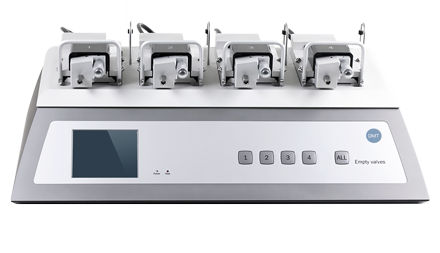
The DMT 630MA is a four-channel automated wire myograph for studying vascular function in small tubular segments. It combines classic isometric wire myography with automated normalization, integrated heating, gassing, drainage and direct data streaming for high-throughput vascular reactivity studies.
The 630MA is suited for laboratories that need reproducible small-vessel myography, standardized preload conditions and efficient handling of multiple vessel segments in parallel.
The 630MA automates the normalization procedure so preload tension and initial experimental conditions can be set in a standardized way after mounting and equilibration.
Four chambers support parallel vessel testing, treatment-control comparisons, concentration-response curves and studies where individual vessels must be tested separately.
The chamber design supports ring-mounted vessel segments and can also function as a small organ bath for compatible preparations.
Heating, gassing, drainage, force calibration, selectable force range and interface menu control are integrated into the 630MA workflow.
The system supports both jaws and pins, making it suitable for a range of vascular preparations and vessel sizes.
Multiple units can be arranged side by side and combined with the Buffer Filler System – 625FS for more efficient buffer exchange workflows.
Once vessels are dissected, cleaned and mounted in the four chambers, each segment is maintained under physiological conditions in acid-resistant stainless-steel chambers.
Temperature is maintained through built-in heating, gas inflow is individually controlled, and buffer drainage is handled through a vacuum connection and built-in manifold.
See how the four-channel 630MA combines automated normalization with integrated control of the core functions used in vascular-reactivity experiments.
DMT product videos provide guidance for system introduction, setup, force calibration, cleaning and experimental preparation.
Overview of the 630MA and its principal components.
Practical setup workflow for the 630MA system.
Calibration guidance for consistent force measurement.
Routine cleaning and maintenance workflow.
Example experimental preparation using the 630MA.
The 630MA is suited for pharmacological investigations of vessel reactivity, including concentration-response studies, drug screening and experiments where multiple vessels must be studied in separate baths.
Automatic normalization is particularly useful when consistent initial conditions are required across operators, vessel segments, experimental days and treatment groups.
Measure contraction and relaxation under controlled isometric conditions.
Run parallel pharmacological protocols across four independent chambers.
Increase experimental throughput while maintaining separated chamber conditions.
Study ring-mounted preparations using jaw or pin mounting according to vessel size and protocol.
The following peer-reviewed studies illustrate how researchers have used the DMT 630MA for vascular reactivity and endothelial-function studies across cardiovascular, metabolic and disease models.
Thoracic aortic rings were mounted on a DMT model 630MA for isometric force recording and automated normalization while vascular reactivity was assessed in a study of cytoglobin and angiotensin II-induced cardiac stress.
View publicationLeft anterior descending coronary arteries were mounted on a DMT 630MA to measure isometric tension and endothelium-dependent relaxation after prolonged intermittent-hypoxia exposure.
View publicationArterial segments were mounted on an Automated Multi Wire Myograph System, model 630MA, to assess vascular relaxation and investigate how perivascular adipose-tissue macrophages influence vascular function in type 2 diabetes.
View publicationSecond-order mesenteric arteries were mounted on a DMT 630MA to quantify vascular reactivity and endothelium-dependent vasodilation while examining endothelial Sp1/Sp3 signaling and the effects of captopril.
View publicationPublications are selected to demonstrate representative applications of the 630MA. Inclusion does not imply author endorsement of DMT or its products.
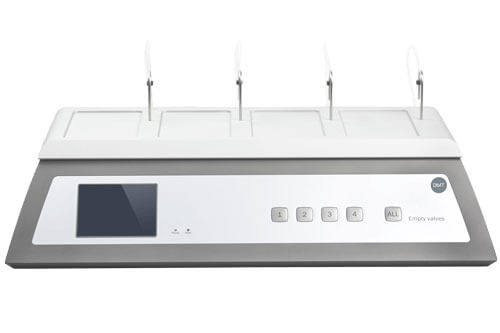
The 630MA combines four myograph chambers with an integrated interface for heating, gassing, automated normalization, drainage, calibration and data communication.
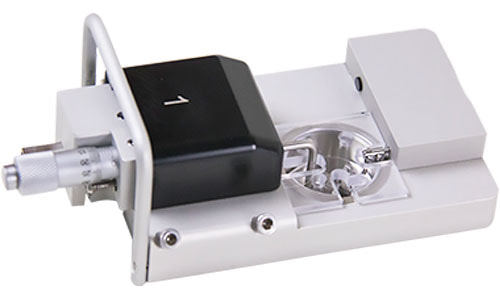
Supports ring-mounted vessel segments using jaw or pin mounting, with precision mechanical adjustment and sensitive isometric force measurement.
Provides control of heating, gassing, drainage, selectable force range, calibration, automated normalization and direct data communication across all four channels.
Core chamber, normalization, temperature, transducer and output specifications for planning a complete 630MA installation.
These resources support mounting, alignment, normalization, mechanical adjustment and maintenance workflows relevant to 630MA operation.
Practical alignment guidance for mounting supports.
Change between compatible jaw and pin supports.
Small-vessel preparation and wire-mounting guidance.
Context for normalization in wire-myograph workflows.
Replacement workflow for the 630MA force transducer.
The appropriate configuration depends on the preparation, data acquisition setup, available laboratory infrastructure and required experimental throughput.
Typical complete workflows include data acquisition, a compatible computer, dissection stereo microscope, light source, dissection tools, heating bath or circulator and vacuum package.
Common additions include the Buffer Filler System – 625FS, installation kit, gas supply manifold, volume-reducing inserts, tungsten wire and mounting pins.
For high-use laboratories, service and maintenance agreements, spare force transducers, extended warranty and training can help maintain uptime and consistency.
The 630MA is a 4-channel automated wire myograph designed to measure isometric force in small blood vessels and tissue rings. It combines high-throughput vascular function studies with automated normalization, helping researchers achieve more consistent and reproducible experimental conditions.
The 630MA is designed for small arteries, veins, and other ring-mounted tissue preparations. It supports both jaw and pin mounting, allowing researchers to study vessels from 30 µm to larger vascular and tissue ring preparations depending on the mounting configuration.
The system measures isometric force, vascular contraction, relaxation, endothelial function, concentration-response curves, and passive length-tension relationships. Four independent chambers allow multiple vessel preparations to be studied simultaneously under controlled conditions.
Normalization determines the optimal passive tension before beginning a wire myography experiment. The 630MA automates this process, helping standardize preload conditions across all four chambers. This improves reproducibility, reduces operator-to-operator variability, and saves valuable setup time in busy laboratories.
The 630MA is ideal for laboratories that prioritize standardization, reproducibility, and efficiency. Automated normalization reduces manual setup, while four independent chambers allow researchers to perform treatment-control comparisons, concentration-response studies, and drug screening with greater consistency.
The 630MA is widely used in vascular physiology, hypertension, diabetes, endothelial dysfunction, vascular pharmacology, atherosclerosis, drug discovery, and small-vessel research where reproducible, high-throughput experiments are essential.
Both systems feature four independent wire myograph chambers, but the 630MA adds automated normalization, making it ideal for laboratories that require standardized workflows and consistent experimental setup. The 620M uses manual normalization and is well suited for researchers who prefer a traditional wire myography workflow.
The 630MA is the best choice if your laboratory performs routine wire myography, runs multiple users or operators, or needs high-throughput, reproducible vascular function studies. If manual normalization meets your workflow needs, the 620M offers the same four-channel format with a more traditional setup.
Use the product data sheet, manuals, normalization guidance, software and support pages when evaluating, configuring or operating the 630MA.
Product overview, applications and technical specifications.
→ PDFDetailed setup, interface, calibration and maintenance documentation.
→ PDFPractical guide for routine system use and workflow reference.
→ PDFDMT normalization reference for wire-myograph workflows.
→ SWData-acquisition software for compatible DMT myograph systems.
→ SWFind DMT installers, drivers and acquisition tools.
→ DMTCompare DMT wire-myograph platforms and measurement workflows.
→ SUPSupport laboratory onboarding and consistent system operation.
→