Designed for large vessels
Mount arteries, veins and other vessel segments with internal diameters from 1.5 to 6.0 mm.
The DMT 110PXL is a pressure myograph for studying the physiological function and properties of large arteries, veins and other larger vessel segments under controlled pressurized conditions. It supports large-vessel reactivity, compliance, myogenic response and pharmacological studies where diameter changes are measured under precisely controlled transmural pressure.
The 110PXL is designed for laboratories that need robust pressure control, a large chamber and low-power optical access for pressurized arteries, veins and other vessels that are too large for standard small-vessel pressure myographs.
Mount arteries, veins and other vessel segments with internal diameters from 1.5 to 6.0 mm.
In-line pressure transducers monitor and support controlled pressure close to the mounted vessel.
Visualize larger vessel segments using low-power objectives and live camera-based diameter tracking.
Maintain stable chamber temperature without depending on continuous superfusion for heating.
Adjust cannula position in three axes for controlled mounting and alignment of large vessel segments.
Support routine cleaning while reducing adhesion of lipids and compounds to the chamber surface.
A large intact artery, vein or other vessel segment is mounted between two large-vessel supports and pressurized to the required transmural pressure. The vessel remains in its tubular geometry while diameter and wall parameters are tracked during pressure, reactivity or pharmacological protocols.
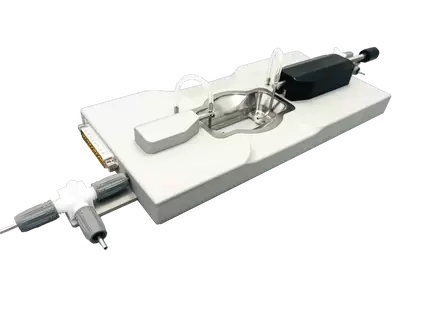
The chamber combines larger mounting adapters, integrated heating, in-line pressure measurement, a large optical window and XYZ positioning for controlled vessel alignment.
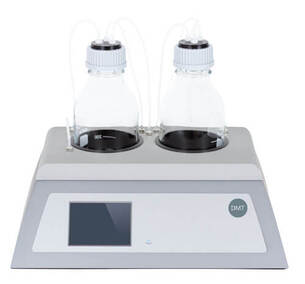
The 110PXL workflow combines the large-vessel chamber with a pressure-control interface and MyoVIEW software for live acquisition and vessel tracking.
Acid-resistant stainless-steel chamber with a large optical window, large-vessel mounts, XYZ alignment, integrated heating and in-line pressure transducers.
Interface unit supporting pressure calibration, heat control, closed pressure-circuit operation, touch-screen menus, USB data communication and analogue outputs.
The 110PXL is used where the dimensions of the vessel make standard small-vessel pressure myographs unsuitable and where diameter change under controlled pressure is the primary endpoint.
Measure diameter changes in response to vasoactive compounds applied to the chamber or luminal solution.
Examine pressure-dependent diameter changes and large-vessel behavior under defined transmural pressure.
Study intrinsic vessel responses during controlled pressure steps and pressure-dependent protocols.
Evaluate large-vessel responses to agents applied to the superfusate or luminal solution.
Compare large-vessel function in hypertension, atherosclerosis, ageing and other vascular disease models.
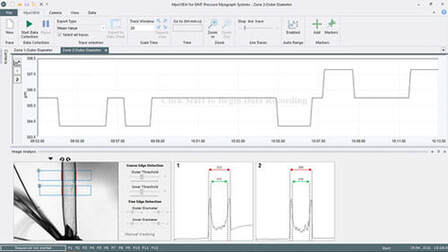
MyoVIEW supports live vessel visualization, pressure control, temperature control, event marking and acquisition of vessel dimensions throughout the experiment.
The software can collect vessel and lumen diameter, wall thickness, intravascular pressure and derived vascular parameters during pressure, compliance and pharmacological protocols.
Core chamber, vessel, temperature, pressure and communication specifications for evaluating the 110PXL.
The appropriate configuration depends on vessel dimensions, imaging requirements, pressure-circuit design, microscope and camera compatibility, mounting accessories and laboratory training needs.
Typical workflows include MyoVIEW acquisition, a suitable computer, inverted microscope, camera, stage micrometer, vacuum package, heating circulator, dissection microscope and dissection tools.
Confirm low-power objectives, camera pathway, vessel-mount dimensions, cannula sizes, suture and pressure-circuit tubing.
Consider installation, vessel mounting training, pressure calibration guidance, spare transducers and service coverage for high-use laboratories.
The 110PXL is designed to study the function and mechanics of large arteries and veins under controlled physiological pressure. It allows researchers to measure vessel diameter, compliance, vascular reactivity, and pressure-dependent responses while maintaining the vessel's natural tubular structure.
The 110PXL is optimized for large arteries, veins, and other tubular tissues with internal diameters from approximately 1.5 to 6.0 mm. It's ideal for studies where vessel size exceeds the range of traditional small-vessel pressure myographs.
The system measures vessel diameter, wall thickness, compliance, vascular reactivity, intravascular pressure, and pressure-dependent changes in vessel function. Using MyoVIEW software, researchers can also calculate additional vascular parameters in real time.
Yes. The 110PXL is specifically designed for arterial stiffness, vascular compliance, and pressure-diameter studies. It enables researchers to investigate how large blood vessels respond to physiological pressure changes, disease, and pharmacological treatments.
A Pressure Myograph preserves the vessel as an intact, pressurized tube, allowing researchers to study diameter changes, compliance, and myogenic responses under near-physiological conditions. A Wire Myograph measures force in ring-mounted vessels and is better suited for isometric contractility studies.
The 110PXL is widely used in vascular physiology, hypertension research, cardiovascular disease, vascular remodeling, arterial stiffness, pharmacology, and translational vascular research where large vessel function is a primary endpoint.
The 110PXL is designed for large arteries and veins (1.5–6.0 mm), making it ideal for large-vessel compliance and reactivity studies. The 114P is optimized for small arteries and resistance vessels where myogenic tone, flow-mediated dilation, and microvascular function are the primary research focus.
The 110PXL is the ideal choice if your research focuses on large artery or vein physiology, vascular compliance, arterial stiffness, or pressure-dependent vessel behavior. If you're studying small resistance arteries or the microcirculation, a system like the DMT 114P may be a better fit.
Use the official product documents and DMT support resources when evaluating, installing or operating the 110PXL.
Product overview, applications, specifications and configuration guidance.
→ PDFDetailed system setup, pressure circuit, interface and calibration documentation.
→ PDFPractical guidance for vessel mounting and routine system use.
→ VIEWLive vessel tracking and analysis for pressure-myograph workflows.
→ DMTCompare the complete DMT pressure-myograph product family.
→ CMPCompare vessel size, pressure, flow, force and imaging capability.
→ HOWReview pressure calibration, leak checks and maintenance guidance.
→ SUPPlan setup, vessel mounting, pressure calibration and user onboarding.
→Share the vessel type, expected internal diameter and segment length, pressure range, microscope and camera setup, objective requirements, mounting accessories and preferred analysis workflow. DMT can help define the appropriate 110PXL configuration.