
DMT
  • Products
    • Muscle Strip Systems >
      • Tissue Puller System - 560TP
      • MyoDynamics Muscle Strip System - 840MD
    • Organ Bath System >
      • Organ Bath System - 751MT
      • Organ Bath System - 752eT
      • Organ Bath System | 820MO
    • Pressure Myograph Systems >
      • Pressure Myograph System - 110PXL
      • Pressure Pulsation Myograph System - 112PP
      • Pressure Myograph System - 114P
      • Pressure Myograph System - 114PB
      • Pressure Myograph System - 114PN
      • Pressure Myograph System - 120CP
    • Wire Myograph Systems >
      • Single Wire Myograph System - 320A
      • Confocal Wire Myograph System - 360CW
      • Dual Wire Myograph System - 420A
      • Multi Wire Myograph System - 620M
      • Automated Multi Myograph System - 630MA
    • Myograph Software >
      • MyoNORM
      • MyoDAQ Acquisition
      • MyoVIEW 5
      • MyoPULSE
    • Accessories & Parts >
      • Buffer Filler System
      • FlowMeter - 162FM
      • Stimulators >
        • Stimulator - CS4+
        • Stimulator - CS8
  • Resources
    • DMT Academy >
      • Product Videos
      • Practical Guides
      • Protocols & Articles
    • Guides & Manuals
    • Training/Installation
    • System Maintenance
    • Software Downloads
  • DMT Insights
    • Latest News
    • Lab Spotlight
    • Installation Stories
  • About us
  • Contact
Pressure Myograph System – 114P

Pressure myography for small isolated vessels under near-physiological conditions

The DMT 114P is a pressure myograph for studying the structure and function of isolated small arteries, veins and other vessel segments under controlled transmural pressure. The system supports myogenic-response studies, flow-mediated dilation, pharmacological testing, longitudinal force measurement and live vessel tracking with MyoVIEW.

Request quote Download data sheet Compare pressure systems
Vessels >40 µm Cannulated small-vessel preparations.
±200 mN force Longitudinal force measurement alongside pressure.
MyoVIEW ready Live diameter, lumen and wall analysis.
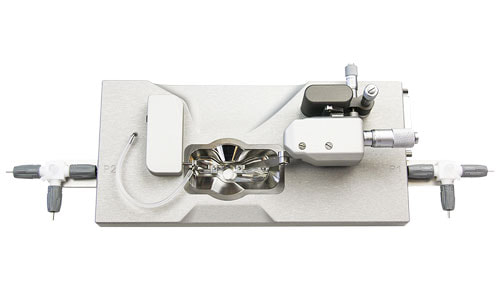
Standard small-vessel platform DMT Pressure Myograph System 114P chamber
Why choose 114P

A versatile platform for pressure, diameter, force and flow-related studies

The 114P is designed for laboratories that need a reliable, adaptable pressure-myograph system for small-vessel physiology, vascular pharmacology and functional analysis.

01

Near-physiological conditions

Study intact tubular vessels under controlled transmural pressure rather than as ring-mounted preparations.

02

Precise cannula alignment

XYZ adjustment and ergonomic chamber geometry support controlled and reproducible vessel mounting.

03

Longitudinal force measurement

Measure axial vessel force independently of pressure and diameter control.

04

Integrated heating

Maintain chamber temperature without relying on continuous superfusion for heat control.

05

Low-volume chamber

A minimum chamber volume of 3.1 mL helps reduce buffer and compound consumption.

06

Imaging compatible

Combine live diameter tracking with fluorescence measurements such as intracellular calcium or pH.

System overview

Cannulated vessel studies with pressure, force and diameter endpoints

A small intact segment of an artery or vein is mounted onto two cannulas and pressurized to the required transmural pressure. This preserves tubular vessel geometry while allowing diameter, pressure, wall dimensions and longitudinal force to be monitored.

The chamber cover includes ports for superfusion, rapid filling and draining, cumulative drug addition and oxygenation. The optical base window supports continuous visualization and MyoVIEW-based vessel tracking.

Constant pressure Maintain controlled transmural pressure from 0 to 250 mmHg.
Optional luminal flow Add FlowMeter – 162FM for flow measurement from 15 to 4,000 µL/min.
Longitudinal force Record axial force independently from pressure and diameter.
Optical base window Visualize the mounted vessel and support live dimension tracking.
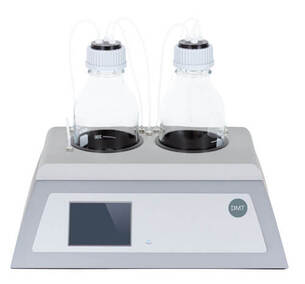
Closed pressure circuit Use the heated 250 mL reservoir and Pressure Interface for controlled operation.
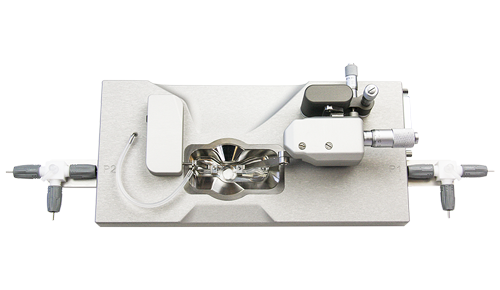
DMT 114P pressure myograph chamber
114P chamber

Compact chamber design for precise small-vessel mounting

The acid-resistant stainless-steel chamber supports cannulated vessel mounting, integrated pressure measurement, longitudinal force recording, XYZ alignment and visualization through the optical base window.

Mounting Glass or stainless-steel cannulas for vessels above 40 µm.
Alignment X, Y and Z adjustment with 0.01 mm micrometer resolution.
Force measurement Longitudinal force range of ±200 mN with 0.01 mN resolution.
Chamber handling Ports support filling, draining, superfusion, oxygenation and cumulative compound addition.
Research applications

Small-vessel physiology, pharmacology and vascular mechanics

The 114P is used when the research question depends on the behavior of an intact pressurized vessel rather than a ring-mounted preparation.

Myogenic tone Flow-mediated dilation Endothelial function Vascular resistance Shear stress Hypertension Artery remodeling Pharmacology Fluorescence imaging
01

Myogenic responses

Study pressure-dependent constriction and dilation under controlled transmural pressure.

02

Flow-mediated dilation

Investigate endothelium-dependent responses to controlled luminal flow.

03

Pharmacological testing

Apply vasoactive compounds to the superfusate or luminal solution and measure changes in vessel diameter.

04

Vascular mechanics

Combine diameter, pressure and longitudinal force data during vessel-stretch or pressure protocols.

05

Fluorescence studies

Combine pressure myography with imaging of intracellular calcium, pH or related vascular signals.

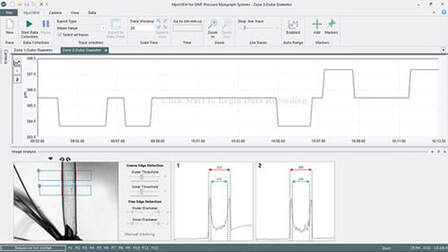
DMT MyoVIEW vessel tracking software
MyoVIEW workflow

Live vessel tracking and pressure-myograph analysis

MyoVIEW records vessel-wall thickness, vessel and lumen diameter, intravascular pressure and calculated vascular parameters during pressure, flow and pharmacological protocols.

Live detection Track vessel and lumen diameter continuously during the experiment.
Multiple scanlines Use several edge-detection zones to improve measurement reliability.
Protocol markers Mark pressure steps, compounds, flow changes and other experimental events.
Calculated outputs Review wall thickness, cross-sectional area, vascular resistance, shear stress and related parameters.
View MyoVIEW Software downloads
Technical data

Key 114P specifications

Core chamber, pressure, force, temperature and communication specifications for evaluating the 114P.

Confirm vessel dimensions, cannula type, microscope and camera setup, MyoVIEW workflow, optional flow measurement and training requirements before ordering.
Chamber
Number of chambers
1
Minimum chamber volume
3.1 mL
Chamber material
Acid-resistant stainless steel
Vessel size
>40 µm
Vessel length
1–10 mm
Vessel alignment
X, Y and Z
Mounting type
Cannulas
Temperature
Temperature range
15.0–50.0 °C
Resolution
0.1 °C
Stability
±0.2 °C
Integrated heating
Yes
Longitudinal force
Output reading
mN
Force range
±200 mN
Force resolution
0.01 mN
Force calibration
Yes
Pressure
Output reading
mmHg
Pressure range
0–250 mmHg
Pressure stability
±0.5 mmHg
Pressure resolution
0.1 mmHg
Reservoir
Heating
Yes
Capacity
250 mL
Pressure circuit
Closed
Air inlet
1 bar maximum
Output
Data communication
USB 2.0
Analogue output channels
4
Analogue output range
±2.5 V
Configuration guidance

Plan the complete 114P pressure-myography setup

The appropriate configuration depends on vessel dimensions, microscope and camera compatibility, cannula format, pressure circuit, optional flow measurement, imaging requirements and laboratory training needs.

Need-to-have equipment

Typical workflows include MyoVIEW, computer package, inverted microscope, monochrome camera, stage micrometer, vacuum package, heating bath or circulator and dissection equipment.

Mounting and flow options

Confirm glass or stainless-steel cannula sizes, pressure tubing, peristaltic pump requirements and FlowMeter – 162FM where flow measurement is required.

Specialized options and support

Rapid-freezing studies can use the 115FP chamber. Installation, cannulation training, spare pressure transducers and service coverage support reliable operation.

Frequently asked questions

Common questions about the 114P

What is the Pressure Myograph System 114P used for?

The 114P is used to study small arteries and veins under near-physiological pressure conditions. It enables researchers to measure vascular function, vessel diameter, myogenic responses, endothelial function, and pharmacological effects while preserving the vessel's natural tubular structure.

What types of blood vessels can be studied with the 114P?

The 114P is designed for small arteries, veins, and other cannulated vessels larger than 40 µm in diameter. It is ideal for resistance vessel studies where maintaining physiological pressure is essential for accurate measurements.

What measurements can the Pressure Myograph System 114P perform?

The 114P measures vessel diameter, wall thickness, myogenic tone, longitudinal force, pressure-diameter relationships, and vascular responses to pharmacological and physiological stimuli. When paired with MyoVIEW, researchers can also calculate vascular resistance, shear stress, and other derived parameters.

Can the 114P be used to study myogenic tone and flow-mediated dilation?

Yes. The 114P is specifically designed for myogenic tone, flow-mediated dilation, endothelial function, vascular reactivity, and pressure-dependent physiology. Optional flow measurement allows researchers to investigate endothelial responses under controlled luminal flow conditions.

Why choose the 114P over a Wire Myograph?

A Pressure Myograph studies intact, pressurized blood vessels, allowing researchers to measure changes in vessel diameter and function under near-physiological conditions. A Wire Myograph measures isometric force in ring-mounted vessels and is better suited for vascular contractility studies. The 114P is the preferred choice when vessel pressure and diameter are key experimental endpoints.

What research applications is the 114P best suited for?

The 114P is widely used in vascular biology, hypertension, diabetes, endothelial dysfunction, vascular remodeling, cardiovascular disease, pharmacology, and microvascular research where small-vessel function is a primary focus.

What's the difference between the 114P and the 112PP Pressure Myograph?

Both systems study small pressurized blood vessels, but the 114P is designed for standard pressure myography with optional flow and longitudinal force measurement. The 112PP adds programmable pulsatile pressure simulation, making it the better choice for researchers who need to replicate pulsatile blood flow or investigate dynamic vascular mechanics.

Is the Pressure Myograph System 114P the right system for my research?

The 114P is the ideal choice if you're studying small-vessel physiology, vascular reactivity, endothelial function, myogenic tone, or pharmacological responses under controlled pressure conditions. If your research requires pulsatile pressure, consider the 112PP. If you don't require longitudinal force measurements, the 114PN offers a streamlined alternative.

Resources

114P documentation and supporting resources

Use the official DMT documents and related pages when evaluating, configuring or operating the 114P.

PDF

114P product data sheet

Product overview, applications, specifications and configuration guidance.

→
PDF

112PP/114P user manual

Detailed setup, pressure circuit, interface and calibration documentation.

→
PDF

112PP/114P user guide

Practical reference for routine pressure-myograph operation.

→
PDF

MyoVIEW user manual

Software documentation for vessel tracking and analysis.

→
VIEW

MyoVIEW software

Live vessel tracking and analysis for pressure-myograph workflows.

→
FLOW

FlowMeter – 162FM

Optional flow measurement for pressure-myograph protocols.

→
CMP

Pressure comparison chart

Compare vessel size, flow, force, pulsation and imaging capability.

→
SUP

Training and installation

Plan system setup, cannulation, calibration and user onboarding.

→
Configuration guidance

Planning a small-vessel pressure-myography study?

Share the vessel type and diameter, pressure range, longitudinal force requirements, flow needs, microscope and camera setup, cannula preference and analysis workflow. DMT can help define the appropriate 114P configuration.

Request a quote Ask DMT for guidance

Products

  • Wire Myographs
  • Pressure Myographs
  • Organ Bath Systems
  • Muscle Strip Systems

Resources

  • DMT Academy
  • Product Videos
  • How-to Videos
  • Protocols & Articles
  • Software Downloads

Support

  • Guides & Manuals
  • Training
  • System Maintenance
  • Ask for Advice

Company

  • About DMT
  • Contact
  • Terms & Conditions
  • Software License
  • Privacy Policy
  • Warranty

Contact

  • Contact DMT Denmark
  • Contact DMT USA
  • Regional contacts

© 2026 Danish Myo Technology A/S

  • Products
    • Muscle Strip Systems >
      • Tissue Puller System - 560TP
      • MyoDynamics Muscle Strip System - 840MD
    • Organ Bath System >
      • Organ Bath System - 751MT
      • Organ Bath System - 752eT
      • Organ Bath System | 820MO
    • Pressure Myograph Systems >
      • Pressure Myograph System - 110PXL
      • Pressure Pulsation Myograph System - 112PP
      • Pressure Myograph System - 114P
      • Pressure Myograph System - 114PB
      • Pressure Myograph System - 114PN
      • Pressure Myograph System - 120CP
    • Wire Myograph Systems >
      • Single Wire Myograph System - 320A
      • Confocal Wire Myograph System - 360CW
      • Dual Wire Myograph System - 420A
      • Multi Wire Myograph System - 620M
      • Automated Multi Myograph System - 630MA
    • Myograph Software >
      • MyoNORM
      • MyoDAQ Acquisition
      • MyoVIEW 5
      • MyoPULSE
    • Accessories & Parts >
      • Buffer Filler System
      • FlowMeter - 162FM
      • Stimulators >
        • Stimulator - CS4+
        • Stimulator - CS8
  • Resources
    • DMT Academy >
      • Product Videos
      • Practical Guides
      • Protocols & Articles
    • Guides & Manuals
    • Training/Installation
    • System Maintenance
    • Software Downloads
  • DMT Insights
    • Latest News
    • Lab Spotlight
    • Installation Stories
  • About us
  • Contact